Short answer: in most US schools, a passing grade is 60% or higher, which is a D. Anything below 60% is an F, which is failing. But many classes, programs and colleges expect at least a C (70%) for the grade to really count.
That's the general rule. Your school sets the exact line, so the details below matter.
The lowest passing grade on common scales
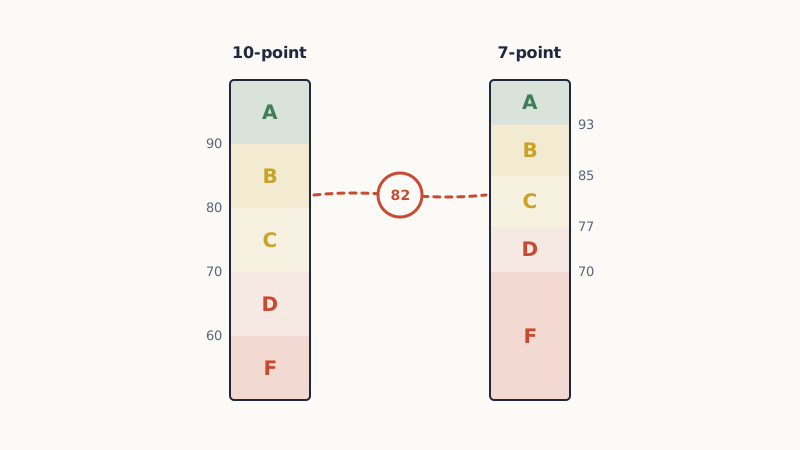
Most US schools use the 10-point scale. A few use a 7-point scale, where everything shifts up.
| Scale | Lowest passing grade | Failing |
|---|---|---|
| 10-point scale (most common) | 60% (D) | Below 60% |
| 7-point scale | 70% (D) | Below 70% |
| Plus/minus scale | 60% (D-) | Below 60% |
| "C or better" classes | 70% (C-) | Below 70% |
Not sure which scale your school uses? Check your syllabus or student handbook. Our letter grade to percentage chart shows every grade on both the standard and plus/minus scales.
Is a 60 passing? Is a 65 or 70 passing?
On the 10-point scale:
- 60% is passing. It's the lowest D. One point less is an F.
- 65% is passing. It's a D.
- 70% is passing. It's a C-, or a plain C on a scale without pluses and minuses.
On a 7-point scale, it's different. A 60 and a 65 are both failing, because a D starts at 70. That's the scale South Carolina used before it switched to the 10-point scale in the 2016–17 school year. Some schools still use it.
Is a D passing?
Yes, in most cases a D is a passing grade. You get credit for the class.
But a D often isn't enough. It's a "pass, but barely" grade, and it can cause problems:
- Prerequisites. Many classes say you need a C or better in the class before it. A D may not let you move on.
- Your major. Lots of college programs only count major classes with a C or higher.
- Graduation. Some high schools need a C in core classes like English or math.
- GPA. A D is worth only 1.0 on a 4.0 scale, so it pulls your GPA down.
Is a D a passing grade in college?
Usually, yes. A D earns credit at most colleges. Policies vary, though. For example, Wright State University accepts transferred classes with a D or higher, but its policy used to require a C.
If you're planning to transfer, count a class toward your major, or keep a scholarship, assume you need a C. Check your college catalog to be sure.
What is a failing grade?
A failing grade is an F. On most scales, that's any score below 60%.
There's no "E" in most US schools. It was dropped long ago, and F stands for "fail". You can read why in why there's no E grade.
Some schools also use "NP" (no pass) or "U" (unsatisfactory) instead of an F in pass/fail classes.
What grade do you need to pass a class?
You need your overall grade for the term to be at least the passing line, usually 60%. One bad test doesn't fail you on its own. It's the average that counts.
Example: you have 55% in a class before the final. The final is worth 20% of your grade. To finish at 60%:
- Your current grade counts for 80%: 55 × 0.8 = 44
- You still need: 60 − 44 = 16 points
- The final has to give you that: 16 ÷ 0.2 = 80% on the final
You can try your own numbers with the final grade calculator. It shows the exact score you need.
What happens if you get a failing grade?
In high school, you usually need to retake the class or make it up through summer school or credit recovery, especially if it's a required class.
In college, an F goes on your transcript and counts as 0.0 in your GPA. Most colleges let you retake the class, and many replace the old grade in your GPA when you do. You'll need to check your school's grade replacement policy.
Frequently asked questions
What percent is failing? Below 60% on the 10-point scale. Below 70% on a 7-point scale.
Is a 59.5 passing? Only if your teacher rounds up. Some round 59.5 to 60, and some don't. Ask, or check the syllabus.
Is a C passing? Yes. A C (70–79%) is passing everywhere, and it meets "C or better" rules.
Is a D- passing? On most plus/minus scales, yes. A D- is 60–62%, the lowest passing grade.
Can a teacher fail you for one assignment? Not usually. Your grade is the average of all your work. One zero hurts, but you can still pass if the rest is strong.