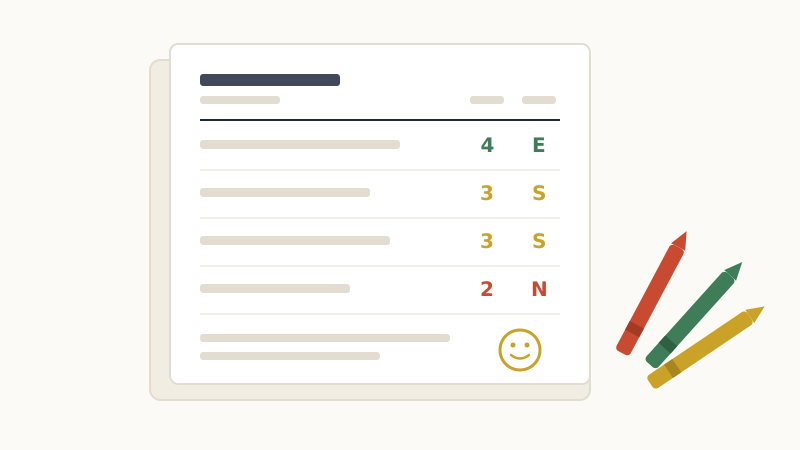
Short answer: most elementary report cards don't use A–F. They use letters like E (Excellent), S (Satisfactory), N (Needs improvement) and U (Unsatisfactory), or numbers from 1 to 4, where 3 means your child is meeting the grade-level standard.
Every district writes its own report card, so the exact meanings vary. Always check the key, usually printed on the card itself. The tables below show the most common meanings.
What the letters mean (E, S, N, U)
This is often called the ESNU scale. Some schools use O (Outstanding) instead of E.
| Letter | Usually means | In plain words |
|---|---|---|
| E or O | Excellent / Outstanding | Doing better than expected |
| S | Satisfactory | Doing what's expected |
| N | Needs improvement | Not quite there yet |
| U | Unsatisfactory | Well below expectations |
What does S mean on a report card? S stands for Satisfactory. It's a good result. It means your child is doing what's expected for their grade.
What does E mean on a report card? On most elementary report cards, E means Excellent. That's the top mark, not a failing grade. (In some older or middle school systems, E was used as a fail, so check the key.)
What does N mean on a report card? N usually means Needs improvement. It's a heads-up that your child is struggling with that skill or behavior.
Other letters you might see
- I can mean "Improving" or "Incomplete". If it's an academic subject near the end of a term, it's often Incomplete. Ask the teacher if you're not sure.
- P often means "Progressing", which is between N and S. In some schools it means "Proficient", which is like an S or a 3.
- NA or a dash means the skill wasn't taught or assessed yet this term.
What the numbers mean (1–4)
Many schools now use standards-based report cards. Instead of one grade per subject, your child gets a number for each skill, like "reads grade-level words" or "adds within 20".
| Number | Usually means | In plain words |
|---|---|---|
| 4 | Exceeds the standard | Going beyond what's expected |
| 3 | Meets the standard | Right where they should be |
| 2 | Approaching the standard | Getting there, still learning |
| 1 | Beginning / not yet meeting | Needs a lot of support |
A 3 is the goal, not a B. This trips up a lot of parents. A 3 means your child has learned what they need to for that point in the year. Many teachers give 4s rarely, because it means working above grade level.
What does a 2 mean on a report card? A 2 means your child is approaching the standard. It's common early in the year, because the standard describes where they should be by the end of the year. A 2 in the first term is often no cause for worry. A 2 on the final report card is worth a conversation with the teacher.
Kindergarten report cards
Kindergarten report cards usually focus on skills, not subjects. You'll often see a checklist like:
- Knows letter names and sounds
- Counts to 100 by ones and tens
- Writes their first and last name
- Follows classroom rules and takes turns
Each skill gets a mark, often on the 1–4 scale or a simple scale like "Secure / Developing / Beginning". The kindergarten grading scale is about readiness, not ranking. Most children get a mix of marks, especially in the first half of the year.
How these compare to A–F grades
There's no official conversion, and schools don't intend these marks to be turned into letter grades. But as a rough guide:
| Elementary mark | Rough A–F match |
|---|---|
| 4 / E / O | A |
| 3 / S | B or high C |
| 2 / N / P (Progressing) | C or D |
| 1 / U | D or F |
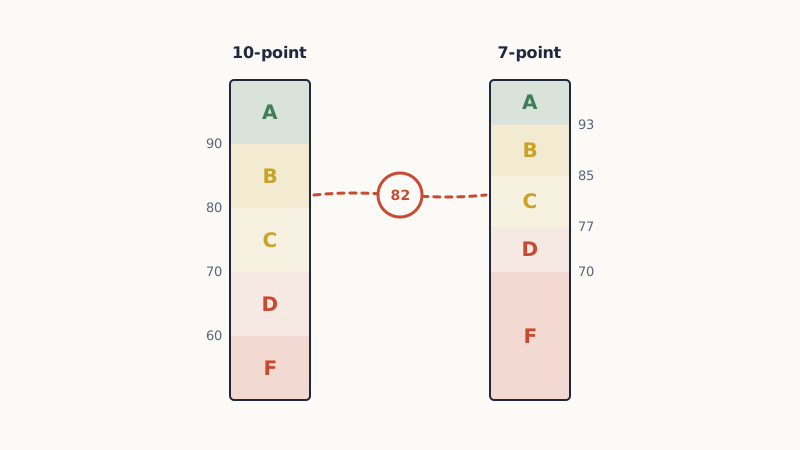
The big difference is that A–F grades often average everything together. Elementary marks show each skill separately, so you can see exactly where your child is strong and where they need help. If your child moves to a school that uses letter grades, you can see the standard percentage ranges on our letter grade to percentage chart.
How to read your child's report card
- Find the key. It's usually on the first or last page. It tells you what each letter or number means at your school.
- Look for patterns. Several N's or 2's in one subject matter more than one in a list of many.
- Read the comments. The teacher's notes often explain the marks better than the marks do.
- Compare to last term. Moving from 2 to 3 is real progress, even if it's not a 4.
Questions to ask the teacher
- "What does this mark mean for where my child should be right now?"
- "Which skill should we work on first?"
- "What can we practice at home?"
- "Is this something to worry about, or normal for this time of year?"
Frequently asked questions
Is S a good grade? Yes. S means Satisfactory, which means your child is meeting expectations.
Is a 3 good on a report card? Yes. A 3 means your child is meeting the grade-level standard. That's the target.
What's the difference between N and U? N (Needs improvement) means your child is behind but making progress. U (Unsatisfactory) is more serious and means they're well below expectations.
Why doesn't my child's school use A–F? Many elementary schools think young children are better served by marks that show specific skills, rather than one grade that averages everything together.
When do elementary students start getting letter grades? It varies. Many schools start letter grades in 3rd to 6th grade. Some keep standards-based marks all the way through middle school.