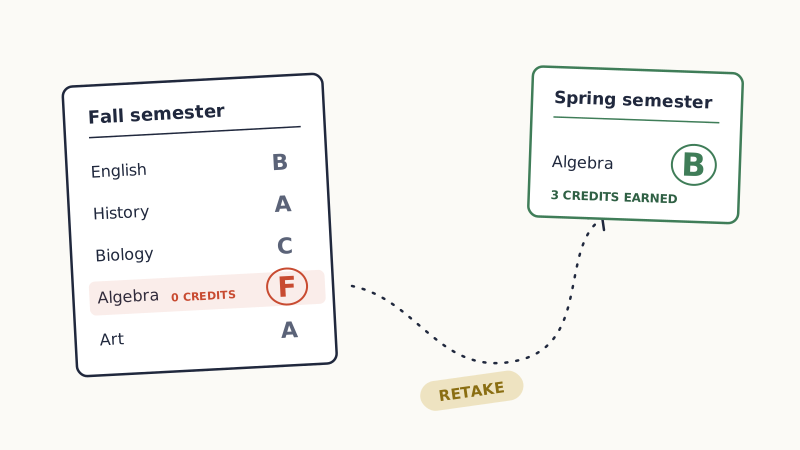
Short answer: if you fail a class, you get an F, which is worth 0 grade points and pulls your GPA down. You also don't earn credit for it, so if the class is required, you'll have to take it again. In college, an F can also affect your financial aid and academic standing. The good news: most schools let you retake the class, and many replace the F in your GPA with the new grade.
Failing a class feels like a disaster, but it's usually fixable. What happens next depends on whether you're in high school or college, whether the class is required, and your school's retake rules.
Not failed yet? Find out exactly what you need. The final grade calculator shows the score you need on your final exam to pass, and the grade calculator shows where you stand right now.
What happens right away
When the final grades are in, a failing grade usually means:
- An F on your transcript. It's recorded for that term. Even if you retake the class later, the original F usually stays visible on your record.
- Zero grade points. An F counts as 0.0 in your GPA. That pulls your average down more than any other grade.
- No credit. You don't earn the credits for the class. That can put you behind on graduation.
- Blocked next steps. If the class is a prerequisite, you can't move on to the next class in the sequence until you pass it.
What counts as failing depends on your school. It's usually below 60%, but some classes and programs need a C or better. See what counts as a passing grade.
How much does an F hurt your GPA?
More than you might think, and the effect depends on how many credits you already have. Here's a student with a 3.2 GPA after 60 credits who takes a 3-credit class:
| What happens | Math | New GPA |
|---|---|---|
| Passes with a C | (192 + 6) ÷ 63 | 3.14 |
| Fails with an F | (192 + 0) ÷ 63 | 3.05 |
| Fails, then retakes for a B. Both grades count. | (192 + 0 + 9) ÷ 66 | 3.05 |
| Fails, then retakes for a B. The B replaces the F. | (192 + 9) ÷ 63 | 3.19 |
How the math works: a 3.2 GPA over 60 credits is 192 grade points (3.2 × 60). An F adds 0 points but still adds 3 credits. A C adds 2 × 3 = 6 points and a B adds 3 × 3 = 9.
Two things stand out. One F drops this student from 3.2 to about 3.05. And retaking the class only really fixes the GPA if your school replaces the old grade instead of averaging both.
The hit is much bigger early on. A first-semester student with a 3.0 in four classes (12 credits) and an F in a fifth (3 credits) ends up with (36 + 0) ÷ 15 = 2.4. The good news is it's just as easy to pull back up, because each new semester carries a lot of weight.
To see what a GPA means as a letter grade, use the GPA converter.
What happens if you fail a class in college?
On top of the GPA hit and lost credit, failing a class in college can affect a few other things.
Academic standing and probation
Most colleges expect at least a 2.0 cumulative GPA to stay in good standing. Drop below that and you may be put on academic probation.
At UNC Charlotte, for example, good standing means a cumulative GPA of at least 2.0 and passing at least two-thirds of the credit hours you attempt. A student whose cumulative GPA is below 2.0 goes on probation. If it's still below 2.0 at the next review, the student can be suspended, unless that semester's GPA is at least 2.3.
One F rarely causes this on its own. Several in one term, or an F on top of an already low GPA, can.
Financial aid
Federal financial aid requires satisfactory academic progress. Each college sets its own rules within federal limits, and they usually check three things:
- GPA. Binghamton University, for example, needs at least a 2.0 cumulative GPA after two years.
- Pace. You have to pass a share of the credits you attempt. At Binghamton it's 67%. A failed class counts as attempted but not passed, so it drags this number down.
- Maximum time. You can't take more than 150% of the credits your degree needs while getting federal aid.
Miss the standard and you usually get a warning semester first. If you still don't meet it after that, aid can stop, though you can usually appeal.
Scholarships often have their own GPA minimum, sometimes 3.0 or higher. Check yours.
Your major
Many majors need a C or better in key classes. If you fail one, you'll have to retake it before you can move on. Some programs, like nursing, also limit how many times you can attempt a class.
Retaking a failed class
Retaking is usually the best fix. How much it helps depends on your college's repeat policy.
Grade replacement. Many colleges let the new grade replace the old one in your GPA. At CU Boulder, an undergraduate can replace a C- or lower, and the new grade counts as long as it's the same or better. At the University of Nebraska–Lincoln, if you retake a class you got a C-, D or F in, only your latest grade counts toward your GPA when you've taken it twice.
The F usually stays on your transcript. Even with replacement, both schools keep the original grade on your record, marked as repeated. It just stops counting in your GPA.
Some colleges average both attempts. Then a retake helps less, as the table above shows. Read your college's policy before you register.
Financial aid can pay for it. Under federal rules, aid can cover retaking a class you've never passed. The University of Utah explains it this way: you can be paid for repeating a failed class, but only one repeat of a class you've already passed.
A retake isn't the only option. You may be able to take the class in summer, online, or at a community college if your college accepts the transfer. Get that approved in writing before you enroll.
What happens if you fail a class in high school?
In high school, failing a class mostly affects credits. Each class you pass earns credit toward graduation. If you fail a required class, like English 10 or Algebra 1, you have to make up that credit to graduate.
Usual ways to make it up:
- Credit recovery. A shorter course, often online, that covers only what you missed. About three-quarters of US high schools had a credit recovery program in 2015–16, and 6% of all high school students took part. In DC Public Schools, any high school student who fails a class needed for graduation can be considered for credit recovery.
- Summer school. Retake the class over the summer.
- Retake it next year. Take the full class again during the school year.
What happens to the F depends on your district. In some, the new grade replaces it in your GPA. In others, both stay on your transcript. Your school counselor can tell you.
Failing one class usually doesn't mean repeating the whole grade. In high school, you lose credit for that class, not the year. But failing several core classes can leave you short of credits and delay graduation.
Does one F ruin your chances?
Almost never. Colleges and employers look at the whole picture, especially your trend. An F in freshman year followed by strong grades tells a story of growth.
If something serious caused the F, like an illness or a family crisis, most college applications have an "additional information" section where you can briefly explain it. Keep it short and factual.
For a sense of what counts as a strong GPA overall, see what is a good GPA.
What to do if you're failing a class
- Run the numbers. Use the final grade calculator to see what you need on the final. Sometimes passing is closer than it feels.
- Talk to your teacher or professor now. Ask what you can still do. Don't wait until grades are posted.
- Check the withdrawal deadline. In college, withdrawing before the deadline usually gives you a W instead of an F. A W doesn't count in your GPA, but it does count as attempted credit for financial aid.
- Get help. Tutoring, office hours and study groups are often free.
- Read the retake policy. If failing is likely, plan when you'll retake the class and whether the new grade will replace the F.
Frequently asked questions
Will an F stay on my transcript forever? Usually, yes. Even when a retake replaces the F in your GPA, most schools keep the original grade on your transcript, marked as repeated.
How many times can you fail a class? It depends on your school and program. Many colleges don't set a limit, but some programs only allow two or three attempts. Federal aid can keep paying for a class you've never passed.
Is it better to withdraw or fail? For your GPA, a W is usually better, because it doesn't count. But both a W and an F count as attempted credits for financial aid, so too many of either can cause problems.
Does failing a class affect financial aid? It can. An F lowers your GPA and your completion rate, and both count toward the rules for keeping federal aid. One F usually isn't enough on its own, but it adds up.
Can you graduate high school if you fail a class? Yes, if you make up the credit. Credit recovery, summer school and retaking the class are the usual ways.
What happens if you fail a final? It depends on how much the final is worth. If it's 20% of your grade and you went in with an 85, even a 40 on the final leaves you at 76, still passing. If it's worth 40% or more, a failed final can sink the class. Plug your numbers into the final grade calculator to see where you'd land.
Can you graduate with a D? Usually, yes. In high school, a D is normally a passing grade that earns credit. In college, a D often counts toward general credits, but many majors need a C or better in key classes, and most colleges need at least a 2.0 overall GPA to graduate.
How do I tell my parents I failed a class? Tell them before they find out on their own, and bring a plan: why it happened, how you'll retake or make up the class, and what you'll do differently. A plan turns the conversation from "what went wrong" into "what happens next".
Do colleges see failed classes? Yes. Colleges usually see your full transcript, including grades you later replaced. A strong upward trend helps a lot.