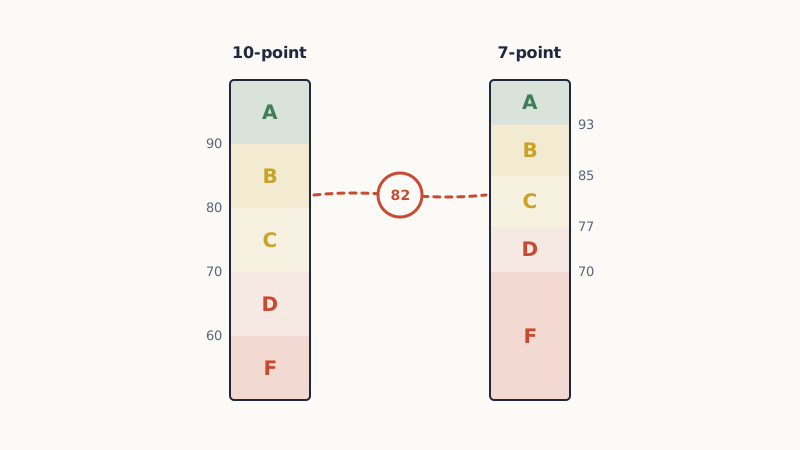
Short answer: on a 10-point grading scale, each letter grade covers 10 points: 90–100 is an A, 80–89 is a B, and so on, with 60 as the lowest passing grade. On a 7-point scale, each grade covers about 7 or 8 points: an A starts at 93 and you need a 70 to pass.
The same test score can earn a different grade depending on which scale your school uses. Here's how they compare.
The 10-point grading scale
This is the most common scale in US schools and colleges.
| Grade | Percentage |
|---|---|
| A | 90–100% |
| B | 80–89% |
| C | 70–79% |
| D | 60–69% |
| F | Below 60% |
It's easy to remember. The first digit of the score tells you the grade.
The 7-point grading scale
A 7-point scale makes each grade band narrower and moves every cutoff up. A common version looks like this:
| Grade | Percentage |
|---|---|
| A | 93–100% |
| B | 85–92% |
| C | 77–84% |
| D | 70–76% |
| F | Below 70% |
The exact cutoffs vary a little from school to school. The key idea is the same: you need a higher percentage for every grade.
Same score, different grade
Here's what a few scores turn into on each scale:
| Score | 10-point scale | 7-point scale |
|---|---|---|
| 95% | A | A |
| 91% | A | B |
| 85% | B | B |
| 82% | B | C |
| 75% | C | D |
| 65% | D | F |
A student with a 65 passes on one scale and fails on the other. That's a big difference for the same work.
How the scale changes your GPA
Because grades turn into GPA points, the scale also changes your GPA.
Example: a student scores 91, 86, 82 and 76 in four classes.
- 10-point scale: A, B, B, C. On a 4.0 scale, that's 4 + 3 + 3 + 2 = 12. 12 ÷ 4 = 3.0 GPA.
- 7-point scale: B, B, C, D. That's 3 + 3 + 2 + 1 = 9. 9 ÷ 4 = 2.25 GPA.
Same scores, but almost a full GPA point lower. This is the main reason many schools have moved to the 10-point scale. Students on a 7-point scale can look weaker on college and scholarship applications than students with the same scores elsewhere.
Who uses which scale?
Most US high schools and colleges use the 10-point scale, often with pluses and minuses added.
The 7-point scale was more common in the past, especially in parts of the South. South Carolina used a 7-point scale statewide until its State Board of Education adopted a uniform 10-point scale. It started with the 2016–17 school year and wasn't applied to older grades.
Some districts and private schools still use a 7-point scale, or a mix. Your syllabus or school handbook will tell you which one applies to you.
Pros and cons
10-point scale
- Simple. Every grade covers the same 10 points.
- Matches most other schools, so GPAs compare fairly.
- Critics say it makes an A too easy to get, and contributes to grade inflation.
7-point scale
- Higher bar for every grade, so an A means more.
- Can hurt students' GPAs compared with students at other schools.
- The cutoffs aren't as standard, so it's harder to compare across schools.
Frequently asked questions
Is a 93 an A? Yes, on both scales. On a plus/minus 10-point scale, it's a plain A.
Is a 70 passing on a 7-point scale? Yes. It's the lowest D. A 69 is an F.
Does a 7-point scale affect college admissions? Colleges see your school's profile and grading scale, and many recalculate GPAs anyway. Still, your raw GPA will look lower, so it's worth knowing.
How do I convert a grade between scales? Use the score, not the letter. Take your percentage and look it up on the other scale. For example, 82% is a C on a 7-point scale and a B on a 10-point scale.
What scale does a plus/minus system use? Most plus/minus systems are built on the 10-point scale. See the full chart on our letter grade to percentage page.