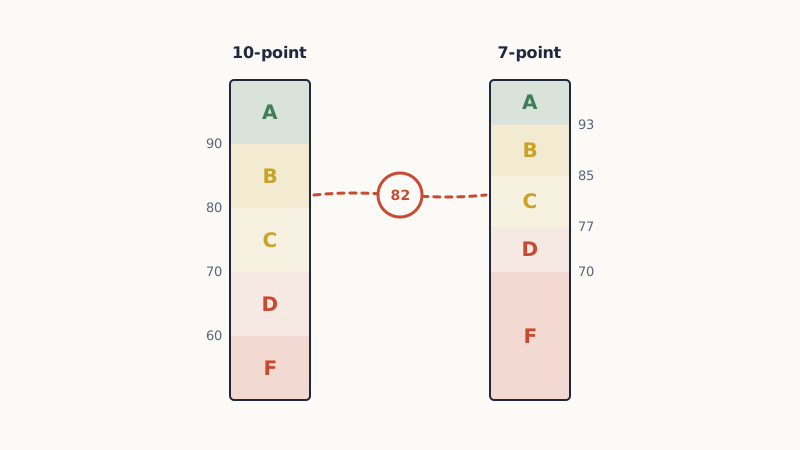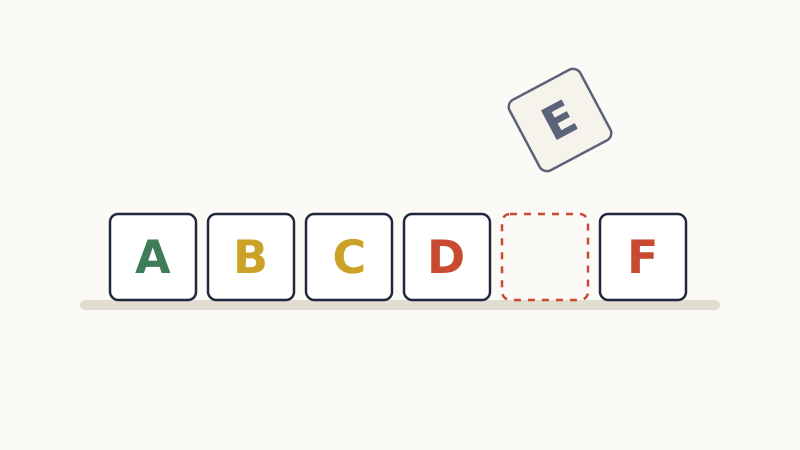
Short answer: most US schools skip E because F stands for "fail", which is clear to everyone. Some early schools did use E as the failing grade, but it was dropped. One common explanation is that people worried students and parents would read E as "excellent".
The A–F scale feels like it's always been there. It hasn't. It's only about 130 years old, and E was part of it at the start.
Where letter grades came from
Early American colleges didn't use letters at all. They ranked students in groups or gave number scores.
- Yale, 1785: students were ranked in Latin categories. "Optimi" (the best) was the top group, followed by second optimi, "inferiores" and "pejores" (the worst).
- Yale, 1800s: Yale moved to a four-point scale in 1813, tried a nine-point scale, then went back to four points in 1832. Four-point scales like this are an early ancestor of today's 4.0 GPA scale.
- Harvard, 1800s: Harvard used number scales, at one point out of 200, and later ranked students in "classes" numbered I to V.
Nobody can point to a single person who invented grades. They grew slowly as colleges got bigger and needed a quick way to compare students.
The first A–E scale
The scale closest to today's came from Mount Holyoke College in Massachusetts in the late 1800s. Sources disagree on the exact year: some say 1887, others 1897.
Their first letter scale looked like this:
| Grade | Meaning | Percentage |
|---|---|---|
| A | Excellent | 95–100% |
| B | Good | 85–94% |
| C | Fair | 76–84% |
| D | Barely passed | 75% |
| E | Failed | Below 75% |
So E was the failing grade. Notice how high the bar was: you needed 75% just to pass.
A year later, the college changed it. It added F as the failing grade below 75%, and E became a low pass. That was the first step toward dropping E.
Why F replaced E
Over the next few decades, A–F spread to schools and colleges across the US. Most skipped E entirely. There are a few likely reasons:
- F is obvious. It stands for "fail". Nobody needs it explained.
- E could be misread. A popular theory says teachers worried students and parents would think E meant "excellent". There's no hard evidence for this, but it's the most repeated reason.
- Simpler is easier. Five letters with one clear fail grade is easy to learn and use.
It's worth noting that A doesn't stand for anything like "awesome", and nobody worried about that. The letters were just an order, with F breaking the pattern because it's an initial.
By the middle of the 1900s, A–F grades were common in most American schools.
Where you'll still see an E
E hasn't fully disappeared. You might see it in a few places:
- Some schools use E instead of F. After World War II, some schools, many in the Midwest, used E as their failing grade. A few still do.
- Elementary report cards. Here E often means "Excellent" or "Exceeds expectations", the opposite of failing. See what E, S, N and U mean on a report card.
- Other countries. Some grading systems abroad use E as a low pass or a fail.
So if you see an E, check the key on the report card before you panic.
What letter grades mean today
The modern scale usually looks like this: A is 90–100%, B is 80–89%, C is 70–79%, D is 60–69%, and F is below 60%. Many schools add pluses and minuses.
You can see the full breakdown, with GPA points, on our letter grade to percentage chart. And if you're wondering where the pass line is, read what counts as a passing grade.
Frequently asked questions
Who invented letter grades? No single person did. Mount Holyoke College is usually credited with the first A–E letter scale in the late 1800s, building on number and ranking systems used at Yale and Harvard.
Did E ever mean failing? Yes. On Mount Holyoke's first letter scale, E was the failing grade. Some schools still use E instead of F.
Why does F come after D? Because it stands for "fail". It isn't really part of the alphabet order.
Why is it called a 4.0 scale? Early colleges like Yale used four-point scales, and the idea stuck. Each letter grade maps to a number: A = 4, B = 3, C = 2, D = 1, F = 0.
Is E a passing grade anywhere? In some places, yes. On some elementary report cards, E means "Excellent". In some other countries' systems, E is a low pass.