Short answer: extra credit is optional work that adds bonus points on top of a class's normal grade. It's up to each teacher (and sometimes the school) whether it's offered, and when it is, most college policies say every student in the class must get the same chance to earn it.
How much extra credit helps depends on how your teacher adds it. Twenty bonus points can lift a grade by two full points, or by less than half a point.
Want to see your own numbers? Put your scores into the grade calculator first. Then use the examples below to see what the bonus would do. If you're aiming at a target, the final grade calculator shows what you need on the final.
What is extra credit?
Extra credit is any chance to raise a grade that sits outside the class's normal grading plan. Lansing Community College defines it as "any opportunity for a student to raise a course grade that is not included in the percentages" in the syllabus.
The key word is optional. If you skip it, your grade doesn't drop. If you do it, your grade can go up.
It comes in a few common forms:
- Bonus questions on a test or quiz.
- Extra credit assignments, such as a short paper, a project or a set of practice problems.
- Points for taking part in something, like a lecture, a museum visit or a study session.
- Test corrections, where you earn back some of the points you lost.
How much does extra credit raise your grade?
It depends on where the points land. Here are two worked examples with real numbers.
Example 1: a points-based class
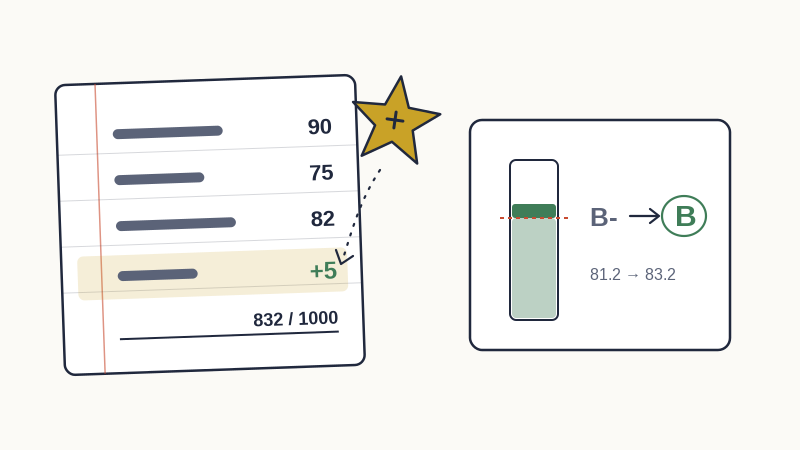
A class has 1,000 points in total. A student has earned 812 of them, so their grade is 812 ÷ 1,000 = 81.2% (a B- on the plus/minus scale).
| What happens | Math | New grade |
|---|---|---|
| No extra credit | 812 ÷ 1,000 | 81.2% |
| 20 bonus points added on top | 832 ÷ 1,000 | 83.2% |
| A 20-point "bonus" assignment that counts like a normal one | 832 ÷ 1,020 | 81.6% |
| 50 bonus points added on top | 862 ÷ 1,000 | 86.2% |
True extra credit only adds to the points you earned, not the points possible. That's why 20 bonus points are worth 2 full percentage points here.
If the teacher adds the work as a normal 20-point assignment, it also adds 20 to the total. Even a perfect score then moves the grade by only 0.4 points.
Example 2: a weighted class
Now a class where tests are 50% of the grade, homework is 30% and projects are 20%. The student's four tests are 80, 75, 82 and 75, so the test average is 312 ÷ 4 = 78. Homework is 90 and projects are 85.
Their grade is (78 × 0.5) + (90 × 0.3) + (85 × 0.2) = 39 + 27 + 17 = 83.0%.
The teacher offers 5 bonus points. Watch what happens depending on where they go:
| Where the 5 points go | Math | New grade |
|---|---|---|
| Nowhere (no extra credit) | 39 + 27 + 17 | 83.0% |
| One test (75 becomes 80) | test average 317 ÷ 4 = 79.25, so 39.625 + 27 + 17 | 83.6% |
| The homework average (90 becomes 95) | 39 + 28.5 + 17 | 84.5% |
| The final course grade | 83.0 + 5 | 88.0% |
Same 5 points, very different results. On one test out of four, they're worth about half a point. Added to the final grade, they're worth a whole letter step, from a B to a B+.
So before you put in hours on an extra credit project, ask how it will be counted.
Extra credit calculator: work it out yourself
You don't need a special extra credit calculator. Use this formula:
New grade = (points earned + extra credit points) ÷ points possible × 100
Leave the points possible the same. That's what makes it extra.
In the grade calculator, choose Points mode and add your bonus to the points earned on one row. For example, a test scored 82 out of 100 with 5 bonus points becomes 87 out of 100. The calculator lets points earned go above points possible, so 104 out of 100 works too.
For a weighted class, add the bonus to the category it belongs to, as in Example 2. If you're not sure where it goes, check your syllabus. Fordham, for example, requires instructors to list "possibilities for extra credit" in the syllabus.
Common extra credit rules
Schools handle extra credit in very different ways. Here's what a few real policies say:
| School | Rule |
|---|---|
| UMass Amherst | Allowed "at the discretion of the instructor"; must be "equally available to all students" |
| Lindenwood University | Optional for the instructor; "must be equally accessible to all students enrolled in the course" |
| Lansing Community College | Can raise a final grade by at most 0.5 on its 4.0 scale; every student in the section must be able to earn it |
| Fordham University | Any extra credit options must be listed in the syllabus |
| Sacramento City Unified (K–12) | Teachers are advised to "avoid extra credit and bonus points" |
Two rules come up again and again.
Same chance for everyone. You usually can't get a private extra credit deal that classmates don't get. UMass adds that teachers should allow for "scheduling, economic, or other obstacles", and offer a reasonable alternative when those are likely.
Tied to the class. Lansing says the work must be "directly related to the Student Learning Outcomes of the course." Bringing in tissues or canned food for points fails that test.
Some K–12 districts go further and don't allow it at all. Education Week reports that some districts have "school- or gradewide policies prohibiting the practice."
Should teachers give extra credit?
Teachers are split. In an informal Education Week LinkedIn poll of 971 people, 39% said yes, 34% said no and 27% said it depends. That's a quick poll, not a survey, but it shows how divided teachers are.
The case for it:
- It gives students one more reason to practice and review.
- It can reward effort beyond the minimum.
- Done well, it's a second chance to show what a student has learned.
The case against it:
- It can blur what a grade means. Sacramento City Unified warns that it "could alter a grade's accuracy for measuring what a student has mastered."
- It isn't always fair. Education Week notes it could favor "students with more resources or time."
- It can teach the wrong lesson, that points matter more than learning.
A middle path many teachers use: offer extra credit that is about the subject, small in value, open to every student, and announced early. If your real goal is to let students show they've caught up, a retake or test corrections often does that job better.
Extra credit ideas
Good extra credit makes students use what the class is about. Here are ideas that pass the "is this about the subject?" test:
- Test corrections: students fix each wrong answer and explain the mistake in a sentence.
- Write the questions: students write five test questions with answers for the next unit.
- Teach it back: a one-page guide or a two-minute video explaining a hard topic.
- Real-world find: spot a concept from class in the news, a recipe, a game or a job, and explain it.
- Extra practice set: a set of problems a step harder than the homework.
- Reflection: a short paragraph on what they got wrong on a test and what they'll do differently.
Extra credit ideas for high school
High school students can handle longer, more independent work:
- Mini research brief: one page on a question from class, with two real sources.
- Primary source analysis in history or English: a speech, letter or data table, with three takeaways.
- Lab extension in science: change one variable in a class lab and predict, test or explain the result.
- Math in context: build a budget, a sports stat comparison or a loan comparison using class formulas.
- Peer tutoring log: help a classmate and write up what you explained and how.
Keep each one small in points and the same for everyone. Then it rewards learning without swamping the main grade.
How to ask for extra credit
Ask early, ask politely, and show you've done the regular work. A teacher is much more likely to say yes in week six than the day before grades are due.
- Check the syllabus first. The answer may already be there.
- Know your numbers. Work out your current grade, and what you need, with the grade calculator.
- Catch up on missing work first. Turning in a missing assignment usually helps more than any bonus.
- Ask for a chance to learn, not just points. "Is there anything I can do to show I've learned this unit?" works better than "Can I have extra points?"
- Accept a no. Many schools require extra credit to be open to every student, so your teacher may not be allowed to make a one-off deal.
Here's a short email you can adapt:
Subject: Question about raising my grade in [Course name, period/section]
Hi [Mr./Ms./Professor] [Last name],
I'm [Your name] from your [Course] class. My grade is currently [grade], and I'd like to bring it up to [target] before the end of the term.
I've turned in [all my missing work / my late assignments]. Are there any extra credit opportunities, test corrections or retakes I could do to show I understand the material better?
I'm happy to come by during [office hours / lunch / after school] if that's easier.
Thank you,
[Your name]
If you think a grade was added up wrong, that's a different conversation. See our guide to grade appeals and emailing a teacher about a grade.
Can extra credit save a failing grade?
Sometimes, but rarely by much. In Example 1, a student at 55% would need 50 bonus points just to reach 60%, the usual passing grade. Few teachers offer that much.
Some schools cap it. Lansing Community College limits extra credit to 0.5 on its 4.0 scale, about half a letter grade. If you're close to failing, talk to your teacher early, and read what happens if you fail a class so you know your options.
Frequently asked questions
Is extra credit worth it?
Usually, if it's offered and you have time. Small bonus points can move a borderline grade, like an 89.4 to a 90. Check first how it's counted, because some extra credit is worth much less than it looks.
Can extra credit go over 100%?
Yes, in many classes. If you earn 980 of 1,000 points and add 30 bonus points, your grade is 101%. Some teachers and schools cap grades at 100%, so check your syllabus.
Do colleges offer extra credit?
Some instructors do, but it's less common than in high school. Policies like those at UMass and Lindenwood leave it to the instructor and require it to be open to every student in the course.
Is it unfair to give one student extra credit?
At many schools it isn't allowed. UMass, Lindenwood and Lansing Community College all require extra credit to be available to all students in the class or section.
Does extra credit count toward GPA?
Only through the final letter grade. Extra credit can change your course grade, and that grade is what goes into your GPA. The bonus points themselves don't appear on your transcript.
When should I ask for extra credit?
As early as you can, ideally by the middle of the term. Asking in the last week often gets a no, because the teacher would have to offer it to the whole class.
What's the difference between extra credit and a bonus question?
A bonus question is one type of extra credit, built into a single test. Extra credit can also be a separate assignment or activity that adds to your overall grade.
What's a good alternative to extra credit for teachers?
Retakes, test corrections and revisions. They let students show what they've learned since the first try, without adding points for work outside the course goals. For ways to keep the extra marking manageable, see how to grade faster.