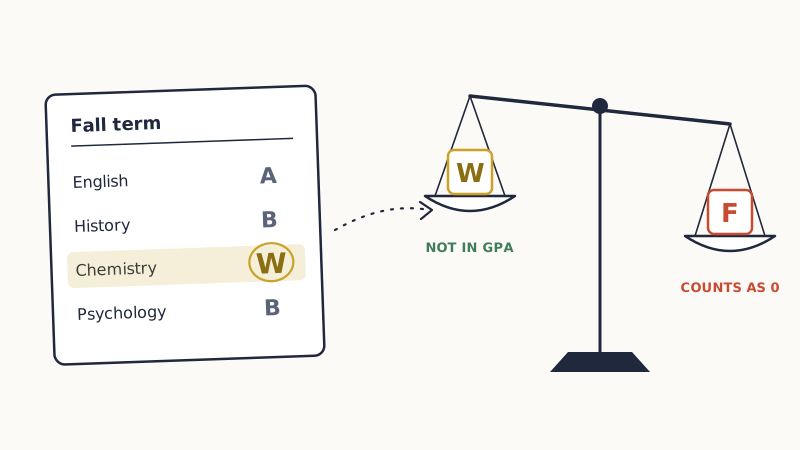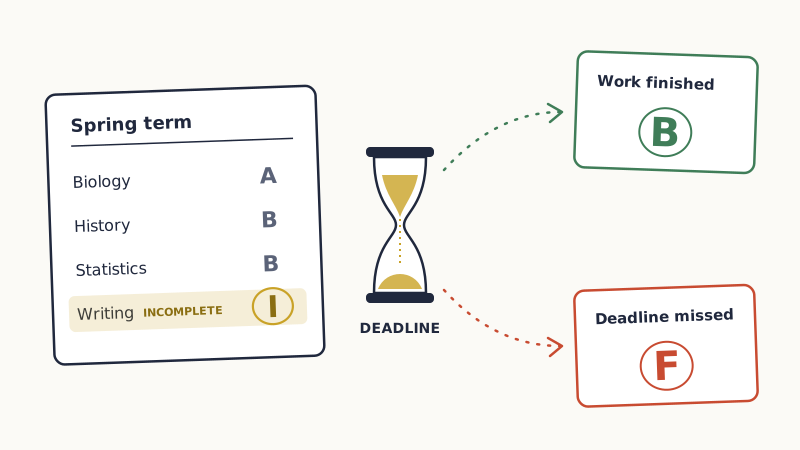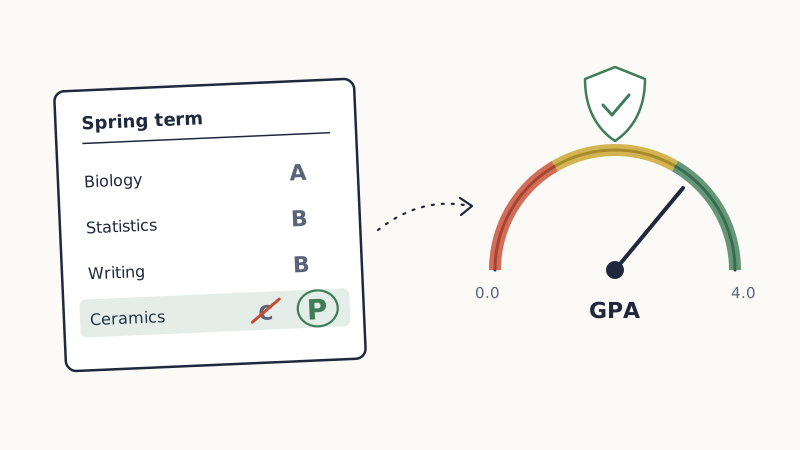
Short answer: with pass/fail grading, a class shows a P (pass) or F (fail) instead of a letter grade. A pass earns credit but usually doesn't count in your GPA. A fail earns no credit, and at some schools it does count in your GPA, just like an F.
Pass/fail is an option most colleges offer for a limited number of classes, usually electives. The rules on what counts as a pass, how many classes you can take and when you must decide vary a lot from school to school.
Weighing it up? Check where you stand first. The grade calculator shows your current grade in the class, and the GPA converter shows what a GPA means as a letter grade.
How pass/fail grading works
You take the class as normal: same work, same tests. The only change is what goes on your transcript at the end.
Your instructor still works out a grade. The registrar then turns it into a P or an F, based on your school's cut-off for a pass. Schools also use other labels for the same idea, such as S/U (satisfactory/unsatisfactory) at Georgia Tech.
What counts as a pass is not the same everywhere:
| School | Lowest grade that counts as a pass |
|---|---|
| UConn | D- |
| Boston University | D |
| University of Illinois (since Fall 2022) | D- |
| Cal Poly (credit/no credit) | C- |
So at Cal Poly, a D+ is a "no credit", while at UConn a D- still passes. If you're unsure where the lines fall in percentages, our guide to what counts as a passing grade has the full scale.
Do pass/fail classes affect your GPA?
A pass doesn't. Georgia Tech says pass/fail grades "will not be included in the calculation of the grade-point average." UConn and Illinois say the same.
A fail depends on the school. At William & Mary, "a Fail will count toward the GPA." Boston University counts an F* in the GPA too. At UConn and Georgia Tech, neither a P nor an F counts.
Here's what that means with real numbers. A student takes four 3-credit classes and gets an A, a B and a B in three of them. The fourth class is taken pass/fail.
| Fourth class | Math | Term GPA |
|---|---|---|
| Letter grade A | (12 + 9 + 9 + 12) ÷ 12 | 3.50 |
| Letter grade C | (12 + 9 + 9 + 6) ÷ 12 | 3.00 |
| Pass (any passing grade) | (12 + 9 + 9) ÷ 9 | 3.33 |
| Fail, school counts it | (12 + 9 + 9 + 0) ÷ 12 | 2.50 |
| Fail, school doesn't count it | (12 + 9 + 9) ÷ 9 | 3.33 (but no credit) |
How the math works: an A is 4 points × 3 credits = 12, a B is 3 × 3 = 9 and a C is 2 × 3 = 6. A pass leaves the class out, so you divide by 9 credits instead of 12.
Two things stand out. Pass/fail protects you from a C pulling your GPA down (3.33 instead of 3.00). But if you'd have earned an A, it costs you (3.33 instead of 3.50). Pass/fail can't raise your GPA; it can only stop it from falling.
Credit/no credit vs pass/fail
Credit/no credit (CR/NC) is the same idea under a different name. You get CR if you reach the cut-off and NC if you don't.
The main difference is usually the failing mark. An NC normally doesn't count in your GPA, while some schools' pass/fail F does. Illinois says credit/no credit courses "are not counted toward the GPA."
There's a catch, though. Illinois also warns that "some institutions may convert the NC grade symbol to a failing grade" when they review your transcript. Graduate schools may treat an NC as an F.
The pass/fail option: common rules
Every school limits it. The rules tend to fall into four groups.
How many classes. Limits are tight. William & Mary allows four courses, Boston University eight units, Georgia Tech nine credit hours, and UConn 12 credits (no more than three courses, one per semester). Cal Poly allows 12 units of credit/no credit.
Which classes. Mostly electives. UConn says pass/fail courses "cannot count towards majors, minors, or gen eds." William & Mary and Boston University also bar major, minor and core requirements. Georgia Tech allows pass/fail only in the Free Electives area.
When to decide. The deadline is often the same as the withdrawal deadline. At Georgia Tech and Boston University, it's the last day to drop with a W. Cal Poly allows it until 50% of the term is over.
Can you change your mind? Sometimes. Georgia Tech and Cal Poly let you switch back to a letter grade before the deadline. At William & Mary the decision is "irrevocable", and at BU it's locked after the W deadline.
Look up "pass/fail" or "credit/no credit" in your school's catalog for the exact rules.
Should I take a class pass/fail? 5 questions to ask
- Is it an elective? If the class counts toward your major, minor or gen eds, pass/fail is usually not allowed, or it won't count toward the requirement.
- What grade am I heading for? Put your scores into the grade calculator. If you're on track for an A or B, a letter grade helps your GPA more than a P.
- Will a fail count against me? Check whether your school counts a pass/fail F in your GPA. If it does, pass/fail won't save you from a failing grade. If failing is the real risk, compare it with a W on your transcript.
- Am I heading to grad, med or law school? Illinois notes that many graduate and professional schools view "a significant number of non-grade symbols less favorably." Some programs want letter grades in prerequisite courses.
- Can I still switch back? Know your school's deadline and whether the choice is final before you sign up.
Pass/fail works best for a class outside your major that you want to try without risking your GPA. It's a poor choice for a class you're already acing, or one a future program needs to see graded.
If a single bad semester is the worry, also read what happens if you fail a class and, for a late emergency, the incomplete grade guide.
Do medical schools accept pass/fail classes?
Some do, with conditions. The University of Pittsburgh School of Medicine says it accepts pass/fail for prerequisite courses. But students in its guaranteed admission program "must obtain letter grades for all required pre-requisite course work."
Policies differ between schools and change over time, so check each program you plan to apply to. Cal Poly adds that some post-baccalaureate programs "penalize students for a grade of CR." When in doubt, take prerequisites for a letter grade and talk to your pre-health advisor.
Pros and cons of pass/fail grading
Pros:
- A low passing grade won't pull down your GPA.
- You can try a hard class outside your major with less pressure.
- It can free up time and energy for the classes that matter most to you.
Cons:
- A good grade won't raise your GPA either.
- At some schools, a fail still counts like an F.
- It rarely counts toward major or general education requirements.
- Grad schools and some employers may want to see letter grades.
Frequently asked questions
Is a P good on a transcript?
A P shows you passed and earned the credit. One or two P grades in electives are normal. A transcript full of them can make it harder for grad schools to judge your work.
What grade do you need to pass a pass/fail class?
It depends on the school. A D- is enough at UConn and Illinois, a D at Boston University, and a C- at Cal Poly for credit/no credit.
Does a pass/fail F affect your GPA?
At some schools, yes. William & Mary and Boston University count a pass/fail F in your GPA. UConn and Georgia Tech don't.
Can you change a pass/fail class back to a letter grade?
At some schools you can, before a deadline. Georgia Tech and Cal Poly allow it. William & Mary and Boston University don't let you change once the choice is final.
Do pass/fail classes count toward graduation?
Yes, if you pass. A P earns the credits, usually as elective credit. They usually can't be used for major, minor or core requirements.
Do high schools have pass/fail classes?
Some do, often for electives, PE or credit recovery. Rules are set by each district, so ask your school counselor how a P shows on your transcript and whether it counts in your GPA.
Is credit/no credit the same as pass/fail?
Mostly. Both swap the letter grade for a simple pass or not-pass mark. The difference is usually that a no-credit mark doesn't count in your GPA, while some schools count a pass/fail F.