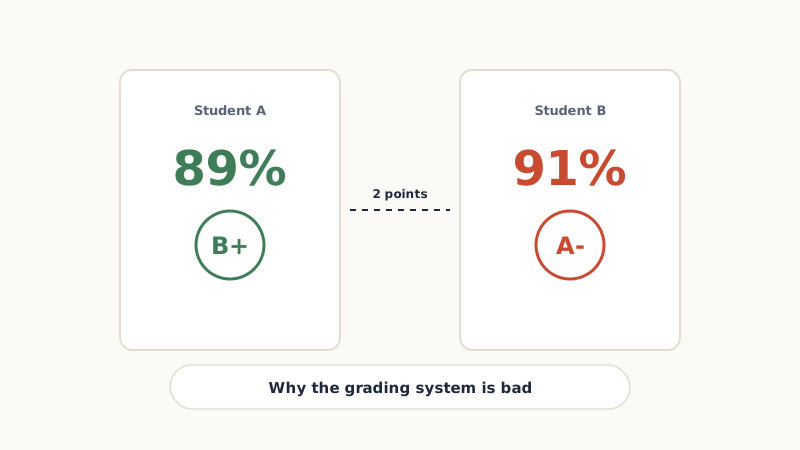
A student walks out of an exam room with 89%. Another earns 91%. One receives a B+, the other an A-. Two percentage points suddenly separate how teachers, parents, and even universities see their performance. That tiny gap often says more about the grading system than the students themselves.
Many people ask why the grading system is bad because it turns learning into a race for numbers instead of understanding. Students quickly discover that the final grade matters more than the skills they actually develop. Once that lesson sinks in, curiosity begins to fade.
Grades were meant to measure academic performance. Over time, they became a shortcut for judging intelligence, work ethic, and future potential. A single letter on a report card now carries far more weight than it was ever designed to.
This changes how students approach school. Instead of asking, "What can I learn?" they ask, "Will this be on the test?" Those are two very different mindsets.
Fear becomes a stronger motivator than curiosity. Students often avoid difficult subjects because a lower grade could damage their GPA. The safest path becomes more attractive than the most educational one.
When grades reward points, not learning
Think about two students taking the same math class. One chooses advanced problems that stretch their ability and scores 82%. Another memorizes procedures, avoids challenges, and scores 94%. The grading system rewards the second student even if the first learned much more.
That pattern repeats across nearly every subject. Students become experts at collecting points rather than building knowledge.
Teachers feel the pressure too. They are expected to fit hundreds of different learning experiences into neat percentages. Real learning rarely works that way.
Imagine grading a classroom discussion. One student asks thoughtful questions but struggles to express ideas clearly. Another repeats information from the textbook with confidence. Turning those different strengths into a number is difficult.
The same problem appears in creative subjects. A history essay may show original thinking but contain grammar mistakes. A polished essay may follow every rule while offering little insight. A final grade often hides these differences.
How the grading system punishes mistakes and growth
The grading system also assumes every mistake deserves a numerical penalty. Learning, however, depends on making mistakes.
A child learning to ride a bicycle falls repeatedly before gaining balance. Nobody counts those falls as permanent failures. School often does exactly that by recording every poor quiz or assignment.
Students who struggle early in a semester can spend months trying to recover. Their understanding improves, but earlier grades continue dragging down the average. The final result may no longer reflect what they actually know.
Consider a student who scores 40%, 55%, 80%, and 95% across four tests. Their average becomes 67.5%. Looking only at the average suggests mediocre understanding, even though the student finished the course performing at a very high level.
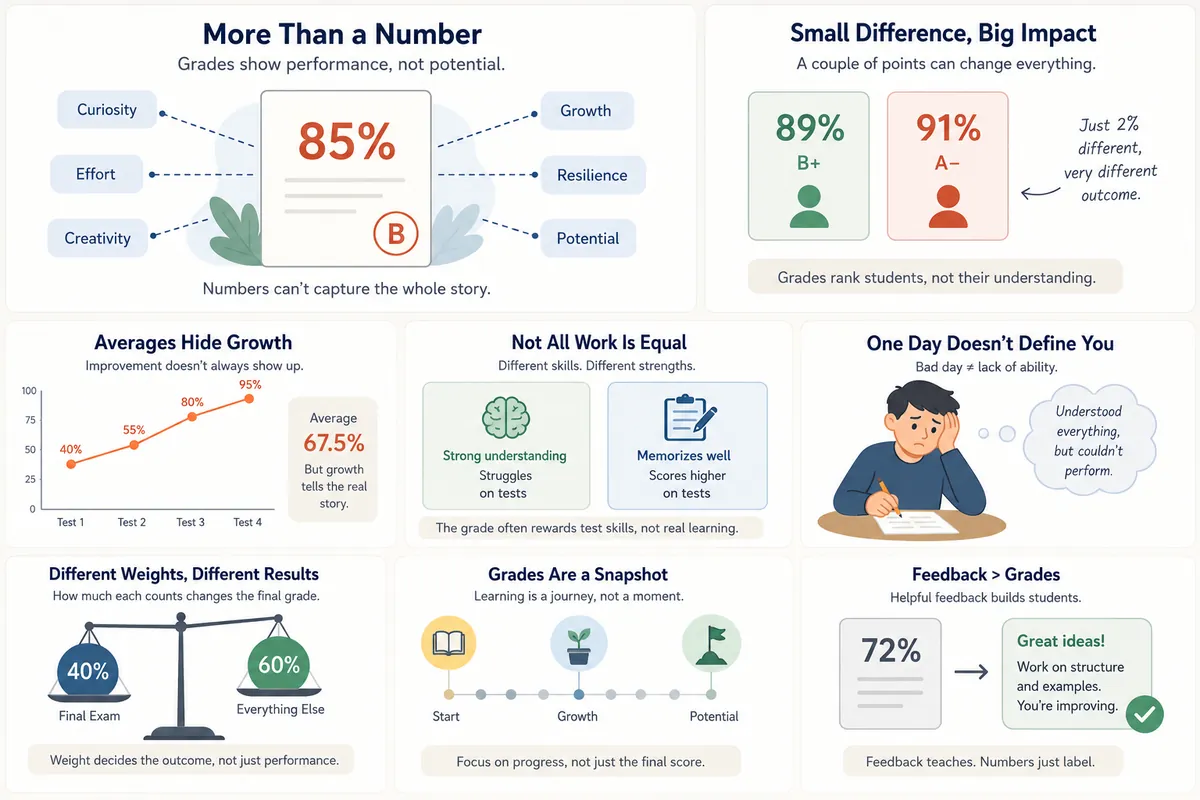
That disconnect frustrates both students and teachers. Growth deserves recognition, yet averages often hide it.
Speed, anxiety, and unfair comparisons
Standardized grading also ignores differences in learning speed. Some students grasp new ideas immediately. Others need extra practice before everything clicks.
Needing more time does not mean someone is less capable. Many successful engineers, writers, and entrepreneurs learned certain subjects slowly before mastering them.
Grades often reward speed as much as accuracy. Timed exams favor students who process information quickly, even when others reach equally strong answers with more time.
Test anxiety creates another problem. A student may understand every chapter but freeze during an exam.
Their grade reflects stress more than knowledge. Anyone who has forgotten an answer under pressure only to remember it minutes later knows this feeling.
Parents also become trapped by grades. Report cards are easy to compare, so conversations often revolve around numbers instead of progress.
A student who improves from 55% to 78% has made remarkable progress. Another who drops from 96% to 91% may receive more praise because the final grade still looks better. The actual story gets lost.
What grades cannot measure
Universities and employers have relied on grades for decades because they provide a simple filter. Simplicity does not guarantee fairness.
A GPA cannot measure resilience after failure. It cannot measure creativity, teamwork, leadership, or persistence. Those qualities often shape long-term success more than exam scores.
Research projects highlight this weakness. One student may organize the team, solve unexpected problems, and motivate classmates while another writes most of the report. A single grade rarely captures each person's contribution.
Teachers know this better than anyone. Many can identify students whose grades underestimate their abilities.
They also know students who consistently earn high marks through memorization while struggling to apply knowledge in unfamiliar situations. Grades sometimes reward short-term recall instead of lasting understanding.
Technology has made this problem more visible. Students can memorize facts that search engines or AI tools can provide in seconds. Schools still spend enormous energy measuring information that may never need to be memorized.
The modern workplace values problem-solving far more than remembering isolated facts. Employees are expected to ask good questions, adapt quickly, and communicate effectively.
Many classrooms still reward the opposite behavior. Students receive higher grades for reproducing expected answers rather than exploring new ideas.
This discourages intellectual risk-taking. When every assignment affects a final grade, students naturally become cautious.
They choose familiar topics instead of ambitious ones. They avoid experiments that might fail. Learning becomes less adventurous because mistakes carry permanent consequences.
Better alternatives to letter grades
Some schools have started experimenting with different assessment methods. Students receive detailed feedback instead of simple letters or percentages.
Written feedback explains strengths, weaknesses, and next steps. That information helps students improve much more than seeing an 83% written at the top of a paper.
Portfolio-based assessment offers another approach. Students collect work completed across an entire semester, showing progress over time rather than relying on a few exams.
A student who struggled during September but produced excellent work by December has evidence of genuine growth. That tells a richer story than one average number.
Weighted grading is another reality students navigate every term. A weighted grade calculator can show how much each assignment type affects the final result, but it cannot fix the deeper problem that one number still stands in for a whole semester of learning.
None of these systems are perfect. Measuring learning will always involve judgment because people learn in different ways.
The goal should be helping students improve rather than sorting them into categories. Assessment should encourage effort, reflection, and deeper understanding instead of constant comparison.
Why the grading system is bad — and what to do about it
So, why the grading system is bad remains a question worth asking. The answer is not that grades have no value. The problem is that society asks them to measure far more than they realistically can.
A report card cannot summarize a person's curiosity, determination, creativity, or potential. Those qualities often appear slowly, sometimes long after school ends.
Students deserve feedback that helps them grow instead of labels that define them. Teachers deserve assessment tools that reflect the complexity of learning. Education works best when understanding matters more than chasing the next percentage point.