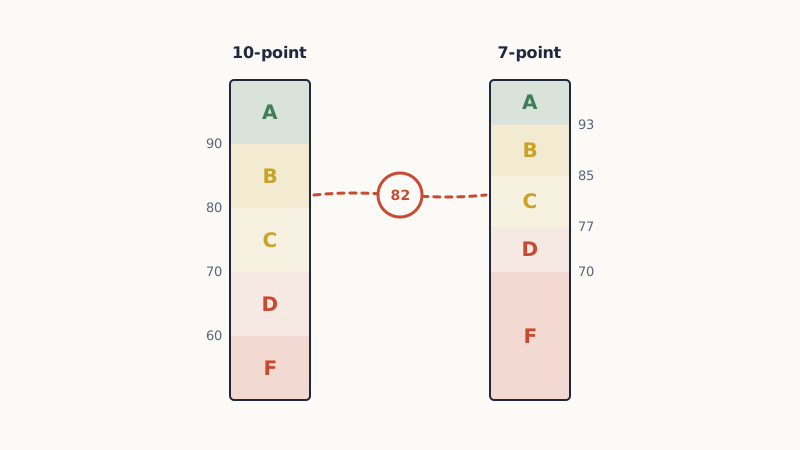
Short answer: an A (90% or higher) is excellent, a B (80–89%) is a good grade, and a C (70–79%) is average. A D is passing but weak, and an F is failing. Whether a grade is "good enough" depends on your goals.
A grade means different things to different people. A B might be a win in a hard class and a letdown in an easy one. Here's a simple way to think about it.
What each grade usually means
| Grade | Percentage | What it usually means |
|---|---|---|
| A | 90–100% | Excellent. You've mastered the material. |
| B | 80–89% | Good. You understand it well, with a few gaps. |
| C | 70–79% | Average. You've got the basics. |
| D | 60–69% | Passing, but weak. Big gaps remain. |
| F | Below 60% | Failing. You haven't met the minimum. |
This uses the standard 10-point scale. Some schools set the cutoffs higher. See the full letter grade to percentage chart for plus and minus grades.
Is a B a good grade?
Yes. A B is a good grade. It means you understand most of the material and did solid work.
A B is worth 3.0 on a 4.0 GPA scale. A student with mostly B's has about a 3.0 GPA, which is right around the average for US high school and college students.
When is a B not good enough? If you're aiming for a very selective college, a competitive major, or a scholarship with a high GPA cutoff, you may need more A's than B's.
Is a C average?
Yes. A C was designed to be the "average" grade, and that's still how most teachers think of it. It means you met the basic expectations.
In practice, average grades have drifted up over the years. Today A's and B's are the most common grades in many schools and colleges, so a C can feel below average even though it isn't a bad grade on paper.
Is a C a bad grade?
Not on its own. A C is a passing grade, and one C won't ruin your record.
But a C can be a problem in a few cases:
- "C or better" rules. Some classes and majors need a C to count. A C- may not be enough.
- Prerequisites. You might need more than a C to take the next class in a sequence.
- GPA goals. A C is worth 2.0. Several C's will pull your GPA below 3.0.
- Scholarships. Many need a 3.0 GPA or higher to keep them.
If you got a C in a class you care about, look at what pulled it down. Often it's one category, like homework or one big test, and that's fixable.
Is a B bad?
No. A B is above average. Some students feel a B is bad because they're used to A's, but most colleges and employers see a B as a solid grade.
What's a good grade in high school vs college?
High school: a mix of A's and B's is strong for most college applications. Selective colleges want mostly A's, especially in harder classes like AP or honors.
College: grades usually matter most for grad school, competitive jobs, and keeping scholarships. A 3.0 GPA (a B average) is a common minimum. A 3.5 or higher is considered very good.
How to tell if your grade is "good enough"
Ask yourself three questions:
- Does this class need a minimum grade? Check for "C or better" rules in your major or program.
- What GPA am I aiming for? One B won't drop a 3.8 much, but several will.
- Is it improving? An upward trend matters to teachers and admissions officers.
Want to see where you stand? The grade calculator shows your overall grade in a class, and you can play with what-if scores.
Frequently asked questions
Is an 85 a good grade? Yes. An 85 is a solid B on the standard scale.
Is a 75 a good grade? A 75 is a C, which is average. It's passing, but not strong.
What grade is considered failing? An F, which is usually below 60%. See what counts as a passing grade for the details.
Is a B+ good? Yes. A B+ (87–89%) is close to an A and well above average.
Do grades really matter? They matter most for college admissions, scholarships and some jobs. But a single grade rarely decides anything on its own. Steady effort and improvement count too.