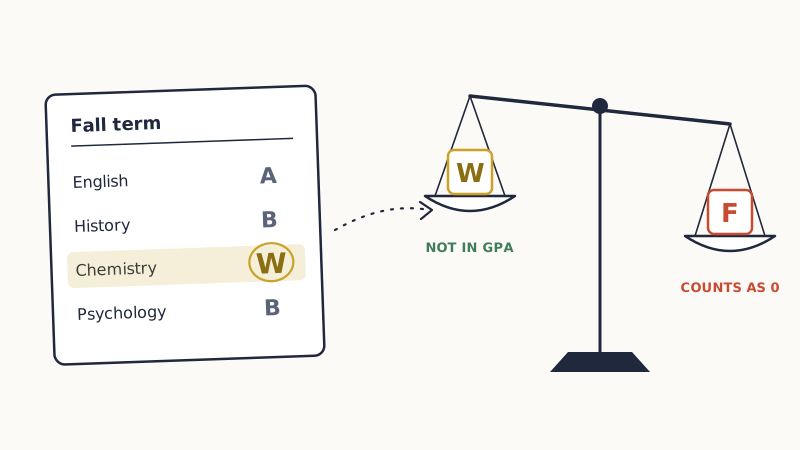
Short answer: a W on a transcript means you withdrew from the class after the add/drop period ended. It isn't a grade, so it doesn't count in your GPA. But it stays on your record, and it usually counts as attempted credit for financial aid.
A W is the most common "not a grade" mark on a college transcript. It tells a reader you started the class and left it before the end.
Deciding whether to withdraw? Start with the numbers. The final grade calculator shows what you'd need on the rest of the class to pass, and the grade calculator shows where you stand right now.
What does W mean on a transcript?
W stands for withdrawal. Rutgers puts it simply: a W "is neither a grade nor punitive." It's a note from the registrar that you left the class after the add/drop period.
Timing decides what shows up:
- Drop early (during add/drop): the class disappears. At UW–Stevens Point, a class dropped by the eighth day of classes doesn't appear on your record at all.
- Withdraw later (before the withdrawal deadline): you get a W.
- Leave after the withdrawal deadline: at many schools you can't withdraw any more, or you get a WF (withdrew failing).
- Just stop going: you don't get a W. You get the grade you earned, often an F.
Every school sets its own dates. Look for "last day to withdraw" in your academic calendar, not the add/drop date.
Does a W affect your GPA?
No. A W has no grade points, so it's left out of your GPA. Clayton State's catalog says a W "is not included in the calculation of the Grade Point Average." UNC Wilmington says the same: a W "has no impact on your GPA."
That's the big difference from an F. Here's a student taking four 3-credit classes. They have an A, a B and a B, and they're struggling in the fourth class:
| Result in the fourth class | Math | Term GPA |
|---|---|---|
| W (withdrew) | (12 + 9 + 9) ÷ 9 | 3.33 |
| C | (12 + 9 + 9 + 6) ÷ 12 | 3.00 |
| D | (12 + 9 + 9 + 3) ÷ 12 | 2.75 |
| F (or WF) | (12 + 9 + 9 + 0) ÷ 12 | 2.50 |
How the math works: an A is 4 points × 3 credits = 12. A B is 3 × 3 = 9. A C is 2 × 3 = 6, a D is 1 × 3 = 3, and an F is 0. The W leaves the class out completely, so you divide by 9 credits, not 12.
So for this student, a W instead of an F keeps the term GPA at 3.33 instead of 2.50. To see what any GPA means as a letter grade, use the GPA converter.
Withdraw vs fail: W, WF and F compared
A W and an F look like two bad options, but they're treated very differently. A WF is the one to watch: it's a withdrawal that counts like an F.
| Mark | What it means | Counts in GPA? | On your transcript? |
|---|---|---|---|
| Dropped (no mark) | Left during add/drop | No | No |
| W | Withdrew before the withdrawal deadline | No | Yes |
| WF | Withdrew after the deadline while failing | Yes, like an F | Yes |
| F | Finished (or stopped going) and failed | Yes | Yes |
Clayton State gives a WF automatically if you withdraw after the published date, unless you get a hardship exception, and says "a WF counts in the calculation of the GPA just like a grade of F." Tulane treats a WF the same way. Tulane also has a UW (unofficial withdrawal) for students who stopped attending, and that counts as an F too.
For your GPA, a W is better than an F. But neither one earns credit, so you'll still need to retake the class if it's required. If an F is already likely, read what happens if you fail a class before you decide.
How a W affects financial aid
This is the part most students miss. For federal aid, a W usually counts as attempted but not earned credit.
Binghamton's policy says "'W' grades, repeat courses, and transfer credits count toward attempted credits." Utah State says any W "counts as attempted but not earned, which hurts your Pace."
Pace is the share of attempted credits you actually complete. At both schools it has to be at least 67% for undergraduates. Your school's exact rule is in its satisfactory academic progress (SAP) policy.
Worked example. You attempt 15 credits a term for two terms, so 30 credits in total.
- You withdraw from two 3-credit classes: you earn 24 of 30 credits. 24 ÷ 30 = 80%. You're above 67%.
- You withdraw from four 3-credit classes: you earn 18 of 30 credits. 18 ÷ 30 = 60%. You're below 67% and could lose aid.
One W is rarely a problem. A pattern of them can be. Rutgers warns that "too many notations of W may make you ineligible to receive future aid."
Dropping a class can also take you below full-time. UT Arlington notes that this "can affect financial aid, scholarships, and insurance coverage." Talk to your financial aid office before you withdraw, not after.
Are there limits on how many Ws you can get?
Some schools and states set a cap.
- Texas: under the state's six-drop rule (Texas Education Code 51.907), students who first enrolled at a Texas public college in fall 2007 or later can drop no more than six courses during their undergraduate career. Withdrawing from all your classes in a term doesn't count toward the six.
- UNC Wilmington: has a 16-hour course withdrawal threshold. Full-term withdrawals and withdrawals for extenuating circumstances don't count toward it.
Many other schools have no fixed number. Check your catalog for "withdrawal limit" or "drop limit".
Do Ws look bad to grad schools and employers?
One or two usually don't. Rutgers says a W "does not suggest anything to future employers or graduate schools." An advising essay from Wesleyan agrees that employers rarely care, but notes that several Ws "may just beg the question, 'Why?'"
What matters is the pattern. A single W in a hard term reads as a sensible call. A W every term reads as a planning problem. If you have a few, be ready to explain them briefly in an application.
Should I drop a class? 5 questions to ask
- Can I still pass? Put your scores into the final grade calculator. If you'd need 110% on the final, the answer is clear.
- When is the deadline? Find the last day to withdraw with a W. After it, you may only have a WF or the grade you earn.
- What does it do to my aid? Ask the financial aid office about your pace and full-time status before you submit.
- Is the class required? If it's a prerequisite, a W means retaking it, and that can push back later classes or graduation.
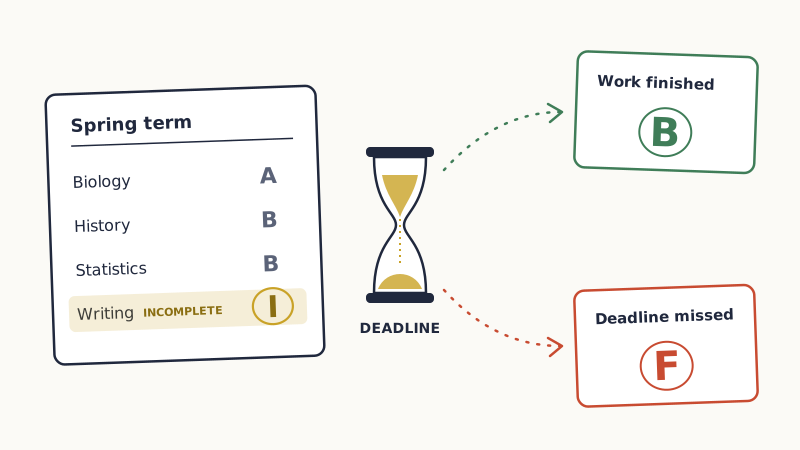
- Is there a better option? If an illness or emergency hit late in the term and you were passing, an incomplete grade may be better than a W. Talk to your instructor first.
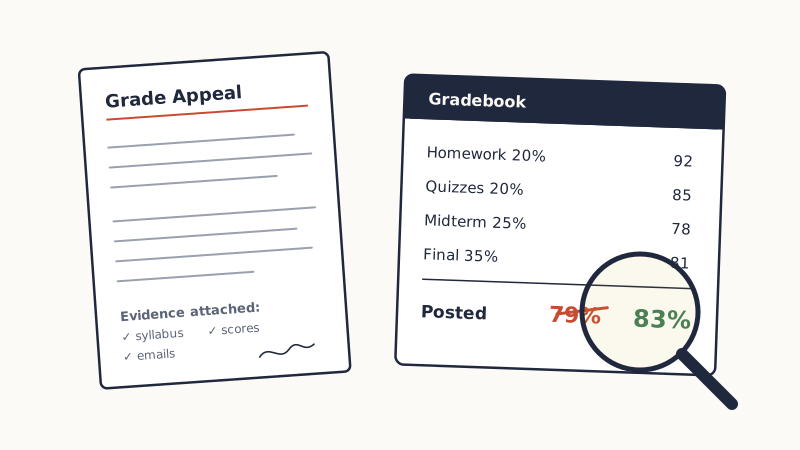
If you're failing because of a grading mistake rather than your work, don't withdraw. Look at how to appeal a grade instead.
Frequently asked questions
Is a W worse than an F?
No, not for your GPA. A W doesn't count in your GPA and an F does. Both count as attempted credits for financial aid, and neither earns credit.
Can a W be removed from your transcript?
Usually not. At most schools a W is a permanent part of your record. If you think it was entered by mistake, ask your registrar.
Does a W affect financial aid?
Often, yes. A W usually counts as attempted but not earned credit, which lowers your completion rate (pace). Too many Ws can put you below your school's minimum, often 67%.
What does WF mean on a transcript?
WF means "withdrew failing". It's given when you withdraw after the deadline, or while failing at some schools, and it counts in your GPA like an F.
What's the difference between dropping and withdrawing from a class?
Dropping happens during the add/drop period and leaves no record. Withdrawing happens later and leaves a W on your transcript.
Does a W count as a failed class?
No. A W isn't a passing or failing grade. It only shows that you left the class before it ended.
Do medical schools or law schools care about Ws?
A W stays on your transcript, so admissions readers will see it. One or two with a clear reason are rarely a problem, but a pattern can raise questions, so be ready to explain them.
Can you get a W in high school?
Some high schools use a W or WF when a student leaves a class after a deadline. Districts set their own rules, so ask your school counselor how it shows on your transcript.