Short answer: an unweighted GPA counts every class the same, so an A is always worth 4.0. A weighted GPA gives extra points for harder classes, usually +0.5 for honors and +1.0 for AP or IB, so an A in an AP class counts as 5.0. That's why a weighted GPA can go above 4.0.
Same report card, two different numbers. If you've ever seen a 3.7 and a 4.1 on the same transcript, this is why. Here's how each one is worked out and which one colleges actually care about.
What is an unweighted GPA?
An unweighted GPA uses the plain 4.0 scale. It doesn't matter if the class is AP Calculus or PE. An A is 4, a B is 3, a C is 2, a D is 1 and an F is 0.
So the highest unweighted GPA is a 4.0. (A few schools give an A+ a 4.3, which can push it slightly higher.)
To see what any GPA means as a letter grade and percentage, use the GPA converter.
What is a weighted GPA?
A weighted GPA rewards you for taking harder classes. Each grade in an honors, AP, IB or dual-enrollment class gets bonus points on top of the normal value.
The most common setup looks like this:
| Grade | Regular class | Honors (+0.5) | AP / IB (+1.0) |
|---|---|---|---|
| A | 4.0 | 4.5 | 5.0 |
| B | 3.0 | 3.5 | 4.0 |
| C | 2.0 | 2.5 | 3.0 |
| D | 1.0 | 1.0 to 1.5 | 1.0 to 2.0 |
| F | 0 | 0 | 0 |
This isn't a national rule. Every school district sets its own weights. Some give AP classes only +0.5, some give no bonus for a D, and some don't weight grades at all. Check your school's handbook or your transcript key.
Weighted vs unweighted GPA: a worked example
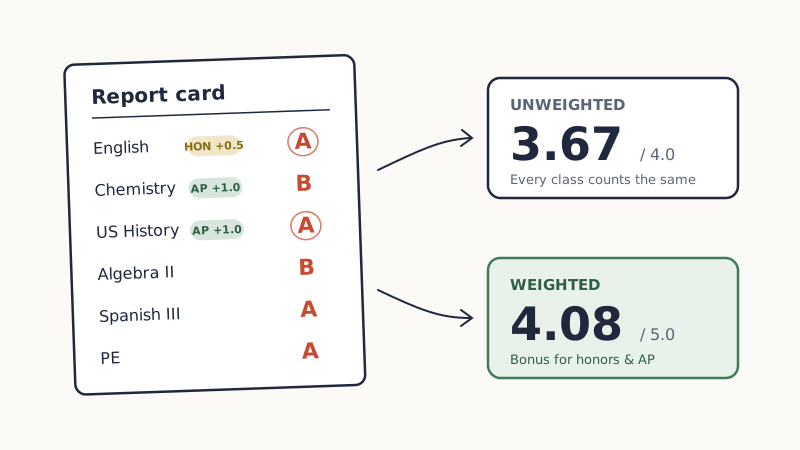
Here's one student's semester, worked out both ways:
| Class | Level | Grade | Unweighted | Weighted |
|---|---|---|---|---|
| English | Honors | A | 4.0 | 4.5 |
| Chemistry | AP | B | 3.0 | 4.0 |
| US History | AP | A | 4.0 | 5.0 |
| Algebra II | Regular | B | 3.0 | 3.0 |
| Spanish III | Regular | A | 4.0 | 4.0 |
| PE | Regular | A | 4.0 | 4.0 |
| Total ÷ 6 classes | 22 ÷ 6 = 3.67 | 24.5 ÷ 6 = 4.08 | ||
Same grades, but the weighted GPA is about 0.4 higher. All of that gap comes from three classes: one honors and two AP.
Notice the B in AP Chemistry. Weighted, it's worth 4.0, the same as an A in a regular class. That's the whole point of weighting: a B in a much harder class isn't treated as a step down.
How do AP classes affect your GPA?
On an unweighted GPA, they don't get any special treatment. An A in AP Biology counts the same as an A in regular Biology.
On a weighted GPA, they usually add a full point. An A becomes a 5.0 and a B becomes a 4.0.
So taking AP classes can raise your weighted GPA even if your grades dip a little. Going from an A in a regular class to a B in an AP class keeps you at 4.0 weighted, but drops you from 4.0 to 3.0 unweighted.
How do honors classes affect your GPA?
Honors classes work the same way, just with a smaller bonus. Most schools add 0.5, so an A in honors is a 4.5 and a B is a 3.5.
Some schools don't weight honors classes at all and only weight AP and IB. And some colleges ignore the honors bonus when they recalculate your GPA, as you'll see below.
Can you convert a weighted GPA to unweighted?
Not exactly, unless you know which classes were weighted. But you can get close with this rule of thumb:
Weighted GPA ≈ unweighted GPA + (share of AP classes × 1.0) + (share of honors classes × 0.5)
In the example above, 2 of 6 classes were AP and 1 was honors: 3.67 + (2/6 × 1.0) + (1/6 × 0.5) = 3.67 + 0.33 + 0.08 = 4.08.
That means the same weighted GPA can hide very different report cards. Here's what a 4.2 weighted GPA might be on the plain 4.0 scale, using AP classes at +1.0:
| Share of classes that were AP | Unweighted GPA behind a 4.2 weighted |
|---|---|
| 20% (1 in 5) | About 4.0 |
| 40% (2 in 5) | About 3.8 |
| 60% (3 in 5) | About 3.6 |
The more weighted classes you take, the bigger the gap. This is also why comparing your weighted GPA to a friend's at another school rarely tells you much.
Which GPA do colleges look at?
Both, but many colleges don't take either one at face value. Because every high school weights grades differently, lots of colleges recalculate your GPA from your transcript using their own rules. They also look at how hard your classes were, separately from the GPA.
The University of California is a well-known example of how strict this can be:
- It only counts approved college-prep classes taken from the summer after 9th grade through the summer after 11th grade.
- Pluses and minuses are dropped: an A- counts as a 4.
- For California residents, each semester of an approved honors-level class (AP, IB Higher Level, and some others) adds 1 point, up to a maximum of 8 points. No more than 4 can come from 10th grade.
- A D or F in an honors class gets no bonus.
So a student with a 4.4 weighted GPA at their high school might end up with a lower GPA in UC's calculation. That's normal, and every applicant is measured the same way.
When an application asks for your GPA, give the one on your transcript and say whether it's weighted and what scale it's on. Don't recalculate it yourself unless the application asks you to.
Is a weighted or unweighted GPA better?
Neither is better. They answer different questions.
- Unweighted GPA shows how well you did, plain and simple. It's the easiest way to compare students from different schools.
- Weighted GPA shows how well you did while also giving credit for harder classes.
For judging your own GPA, the unweighted number is the safer one to use. Most GPA ranges you'll see, like the ones in what is a good GPA, are based on the 4.0 unweighted scale.
Should you take AP classes just to boost your GPA?
Take the hardest classes you can do well in. That's the advice most counselors give, and it lines up with how colleges read transcripts.
A few honest trade-offs:
- A low grade still hurts. A C in an AP class is worth 3.0 weighted, the same as a B in a regular class. Unweighted, it's just a 2.0.
- Too many at once can backfire. If five AP classes drop all your grades to C's, both GPAs and your stress level take a hit.
- Rigor counts on its own. Colleges see which classes you took, not just the GPA. A B in a hard class often looks better to them than an A in an easy one.
If you're wondering whether a B is "bad", it isn't. See what counts as a good grade.
Frequently asked questions
Is a 5.0 GPA weighted or unweighted? Weighted. On the unweighted scale the top is 4.0 (or 4.3 at schools that count A+). A 5.0 usually means straight A's in all AP or IB classes.
What is a 4.2 weighted GPA unweighted? It depends on how many weighted classes you took. With a fair number of AP classes, it's often somewhere between 3.6 and 4.0 unweighted.
Can an unweighted GPA be above 4.0? Only at schools that give an A+ a 4.3. Otherwise, 4.0 is the top.
Do dual-enrollment college classes count as weighted? Often, yes. Many high schools weight them like AP classes. Check your school's policy.
Does a weighted GPA matter in college? No. College GPAs are almost always unweighted. Every class is on the same 4.0 scale, and the course credits decide how much each grade counts.
What if I fail an AP class? An F is worth 0 on both scales. There's no bonus for a failing grade, and a D often gets little or no bonus either. See what counts as a passing grade.