Short answer: at colleges with fixed cutoffs, cum laude usually starts at a 3.4 to 3.5 GPA, magna cum laude at 3.6 to 3.7, and summa cum laude at 3.8 to 3.9. Other colleges give honors to a top percentage of each class instead, which often means higher cutoffs. The dean's list is different: it's for one strong semester, usually a 3.5 GPA or higher.
Latin honors appear on your diploma and transcript when you graduate. They're based on your GPA across your whole degree, and every college sets its own rules. Here's what's typical, with real numbers from US colleges.
What the three Latin honors mean
The names are Latin, and they rank from lowest to highest:
- Cum laude means "with praise". This is the first level.
- Magna cum laude means "with great praise". This is the middle level.
- Summa cum laude means "with highest praise". This is the top level, and usually only a small share of students earn it.
To check what any GPA means as a letter grade, use the GPA converter. A 3.5, for example, sits halfway between a B+ and an A-.
Typical Latin honors GPA cutoffs
Many colleges use fixed GPA cutoffs. These are the most common ranges:
| Honor | Typical minimum GPA | Roughly means |
|---|---|---|
| Cum laude | 3.4 to 3.5 | A mix of A's and B's, leaning toward A's |
| Magna cum laude | 3.6 to 3.7 | Mostly A's and A-'s |
| Summa cum laude | 3.8 to 3.9 | Almost all A's |
These are general ranges, not rules. Always check your own college's catalog or registrar page.
Real cutoffs from US colleges
Here's how a few colleges actually do it:
| College | Cum laude | Magna cum laude | Summa cum laude |
|---|---|---|---|
| West Virginia University | 3.4 | 3.6 | 3.8 |
| Appalachian State | 3.45 | 3.65 | 3.85 |
| UT Dallas, School of Management | 3.569 | 3.775 | 3.929 |
| UT Dallas, Natural Sciences and Math | 3.798 | 3.929 | 4.000 |
| University of Notre Dame | Top 30% | Top 15% | Top 5% |
| University of Maryland | Next 5% | Next 3% | Top 2% |
UT Dallas cutoffs are for students graduating from fall 2026 to summer 2027. Notre Dame and Maryland rank students within each college or school, so the GPA you need changes every year.
Fixed GPA vs top percentage: why it matters
Colleges award Latin honors in one of two ways.
Fixed GPA cutoffs. Hit the number and you get the honor, no matter how many other students do too. West Virginia and Appalachian State work this way. You know your target from day one.
Top percentage of the class. Only a set share of graduates get each honor. At Notre Dame, summa cum laude goes to the top 5% of each college. Because so many students have high GPAs, these cutoffs are often higher than the fixed ones. At UT Dallas, cum laude in natural sciences and math needed a 3.798, close to the summa line at a fixed-cutoff school.
If your college uses percentages, look up last year's cutoffs. Most registrars publish them, and they don't usually move much from year to year.
What GPA do you need for cum laude?
At most fixed-cutoff colleges, you need about a 3.4 or 3.5 cumulative GPA. That's roughly a B+ to A- average.
At percentage-based colleges, cum laude can need a 3.6 or more, depending on your major and school.
What GPA do you need for magna cum laude?
Usually around 3.6 to 3.7. That means mostly A's and A-'s, with only a few B+'s.
What GPA do you need for summa cum laude?
Usually 3.8 to 3.9 at fixed-cutoff colleges, and sometimes a perfect or near-perfect 4.0 at percentage-based ones. Summa usually leaves room for only a handful of grades below an A-.
Other rules that can catch you out
GPA isn't the only requirement. Watch for these:
- Credits at your college. Many colleges need a minimum number of credits taken there. UT Dallas needs at least 45 graded credit hours, and Appalachian State needs 30.
- Transfer credits. Grades from other colleges often don't count toward your honors GPA.
- No rounding. Notre Dame calculates cutoffs to the third decimal place and doesn't round. If the cutoff is 3.591, a 3.590 misses it.
- Timing. Some colleges list honors at the graduation ceremony based on your GPA before your final semester, then update your diploma once final grades are in.
- A floor. UT Dallas won't award any Latin honor below a 3.40, whatever the percentages say.
Worked example: can you still reach cum laude?
Say you have a 3.32 GPA after 90 credits, and your college needs a 3.4 for cum laude. You have 30 credits left, so 120 in total.
- GPA points needed at graduation: 3.4 × 120 = 408
- GPA points you have now: 3.32 × 90 = 298.8
- Points you still need: 408 − 298.8 = 109.2
- GPA needed over your last 30 credits: 109.2 ÷ 30 = 3.64
So cum laude is still possible, but you'd need about an A- average from here.
Now try magna cum laude at 3.6: 3.6 × 120 = 432 points, so you'd need 133.2 points from 30 credits, a 4.44 GPA. That's impossible on a 4.0 scale.
The lesson: each year you wait, your GPA gets harder to move. If honors matter to you, the first two years count just as much as the last two.
What GPA do you need for the dean's list?
The dean's list rewards one strong semester, not your whole degree. The most common rule is a 3.5 semester GPA while taking at least 12 graded credits.
Some real examples:
- Texas State: a 3.5 semester GPA on at least 12 credit hours.
- University of Missouri (Arts and Science): a 3.5 semester GPA on at least 12 letter-graded hours, plus a cumulative GPA of 3.0 or higher.
- UW–River Falls: a 3.5 term GPA on at least 12 GPA-affecting credits, with no F's, no incompletes and no repeated courses that term.
Notice the extra conditions. A pass/fail class often doesn't count toward the 12 credits, and one F can knock you off the list even with a high GPA. Some colleges also have a separate president's or chancellor's list for an even higher semester GPA.
Dean's list vs Latin honors
| Dean's list | Latin honors | |
|---|---|---|
| Based on | One semester's GPA | Your whole degree's GPA |
| Typical GPA | 3.5 or higher | 3.4 to 3.9, depending on the level |
| How often | Every semester you qualify | Once, when you graduate |
| Where it shows | Transcript and a college announcement | Diploma and transcript |
You can make the dean's list several times and still miss Latin honors if a few weaker semesters pull your overall GPA down. It works the other way too.
Do Latin honors matter?
They're a nice extra, but rarely a deal-breaker. Employers and grad schools mostly look at your GPA itself, your major, and your experience. Honors give a quick signal that your grades were strong.
If you earn one, list it on your resume after your degree, for example: "B.A. in History, magna cum laude."
For context on what counts as a strong GPA in general, see what is a good GPA.
Frequently asked questions
Is a 3.5 GPA cum laude? At many colleges, yes. A 3.5 meets the cum laude cutoff at schools with fixed cutoffs, like West Virginia (3.4) and Appalachian State (3.45). At percentage-based schools, it may fall short.
Is a 3.9 GPA summa cum laude? Usually, yes, at colleges with fixed cutoffs. At percentage-based colleges with many high GPAs, summa can need a 3.95 or even a 4.0.
Which is higher, magna or summa cum laude? Summa cum laude is the highest. The order is cum laude, then magna cum laude, then summa cum laude.
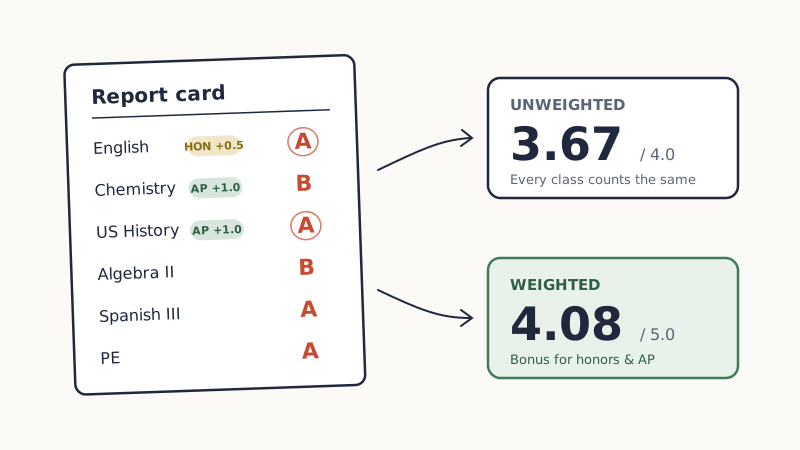
Do high schools give Latin honors? Some do, using their own cutoffs. High schools often use a weighted GPA, so their numbers can be higher than college ones. See weighted vs unweighted GPA.
Do Latin honors use the GPA on my transcript? Usually, yes: your cumulative GPA from courses taken at that college. Transfer grades often don't count.
Is 3.5 the dean's list GPA everywhere? It's the most common cutoff, but not universal. Some colleges use a different number or add rules about credit hours and failing grades, so check your college's catalog.