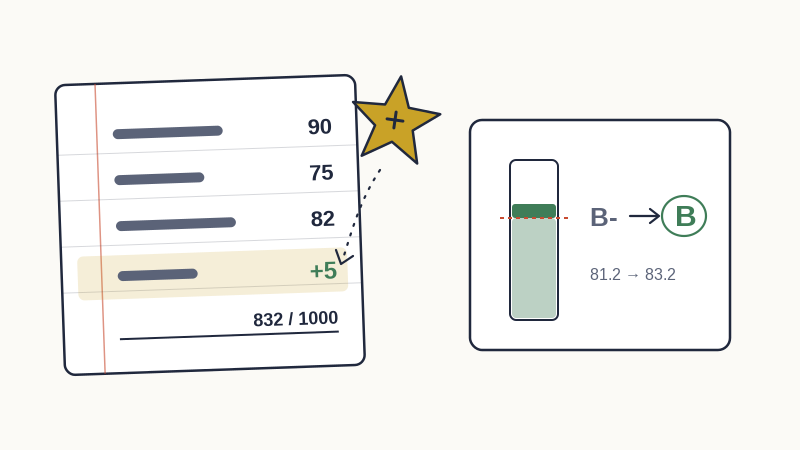
Short answer: ungrading means removing, or greatly reducing, points and letter grades on student work during a course. Students get written feedback, assess their own work and often meet with the teacher. In most schools a final grade still goes on the transcript, but it is set at the end, often with the student's input.
Ungrading isn't one method. It's a family of approaches that all try to move attention from points to learning.
Still using points in your class? The grade calculator works out a weighted or points-based grade in seconds. It's handy for comparing a traditional average with an ungraded portfolio, as in the example below.
What is ungrading?
Duke's Center for Teaching and Learning defines it as "a practice which eliminates or greatly minimizes the use of assigned points or letter grades in a course." Barnard College uses almost the same words.
The phrase was coined by Jesse Stommel, a writing teacher who began removing grades from student work in the early 2000s. It spread widely after the 2020 book Ungrading, edited by anthropologist Susan D. Blum, in which 15 educators describe "going gradeless."
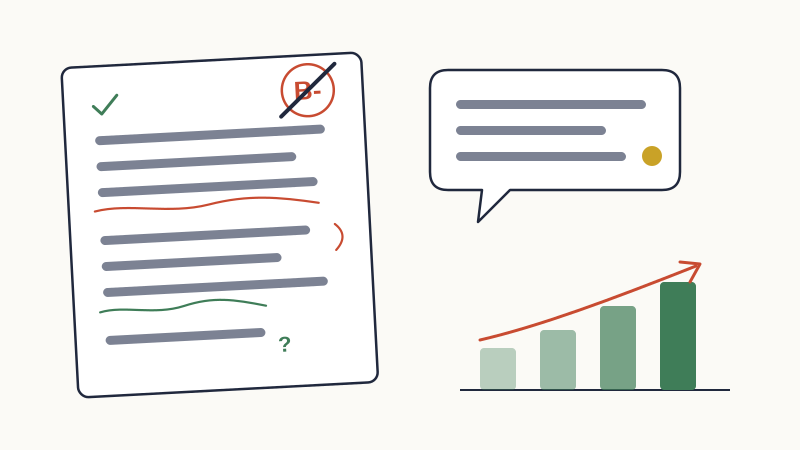
In practice, students still do assignments and still get a response. The difference is the response: comments and questions instead of a 78 or a B-.
How does ungrading work?
James Madison University's teaching center puts it simply: "there's no right way to ungrade." Most courses mix a few of these approaches:
| Approach | What it looks like | Final grade comes from |
|---|---|---|
| Feedback only | Work comes back with comments, no score | Teacher's judgment of the work as a whole |
| Self-assessment | Students write a reflection and propose a grade | Student's proposal, which the teacher can change |
| Grading conference | A short meeting to review the work together | Agreed in the meeting |
| Portfolio | Students collect their best or revised work | The level of the finished portfolio |
| Grade-free zone | Only part of the course is ungraded, often the first weeks | Graded work later in the course |
| Contract or specifications grading | Grades tied to work completed or to meeting clear standards | How many tasks or standards were met |
UMass Amherst treats contract and specifications grading as part of the same "broad category." Some teachers would call those separate systems, since they still produce a grade by rule.
Revision is usually central. Students can redo work after feedback, so a first draft doesn't drag down the final grade.
Is there still a final grade?
Almost always, yes. Duke notes that in most settings a final letter grade "does need to be assigned," either by the teacher or by the student.
A common setup works like this:
- Students get feedback, not grades, all term.
- Near the end, each student writes a reflection on what they learned, with evidence from their work.
- The student proposes a grade.
- The teacher reviews it, sometimes in a short conference, and keeps the final say.
That last step matters. JMU's Emily Gravett tried student self-grading for attendance and engagement. It "worked like a charm" for two semesters, then turned into "a disaster" when students who had missed weeks of class asked for A's. Keeping the right to adjust a grade protects against that.
Worked example: averaging vs. ungrading
Here's why many teachers try ungrading. A student writes four essays over a term and improves a lot.
| Essay | Week | Score if graded |
|---|---|---|
| Essay 1 | 3 | 55% |
| Essay 2 | 6 | 70% |
| Essay 3 | 9 | 85% |
| Essay 4 | 12 | 95% |
Traditional average: (55 + 70 + 85 + 95) ÷ 4 = 305 ÷ 4 = 76.25%, a C. The early essays still count fully, even though the student now writes at an A level.
Ungraded with a portfolio: the student gets comments on each essay, revises, and hands in a final portfolio. The teacher grades the level the student reached by the end, about 95%, an A.
Same student, same work, a two-letter difference. Neither number is "wrong." They answer different questions: how did you do on average? versus what can you do now?
Grading on a curve goes the other way and ranks students against each other. If you need to do that, see the grade curve calculator.
What the research says
The research most often quoted comes from psychologist Ruth Butler in Israel.
In a 1987 study, 200 fifth- and sixth-graders got one of four kinds of feedback on their work: individual comments, number grades, standard praise, or nothing.
| Feedback students got | What happened |
|---|---|
| Individual comments | Highest interest, performance and effort, for both high and low achievers |
| Number grades | Students focused more on ability and comparison than on the task |
| Standard praise | Similar to grades: more focus on ability than on the task |
| No feedback | Lower than comments |
A 1988 follow-up with 132 students compared grades, comments, and grades plus comments. Comments alone did best. Adding a grade seemed to cancel out the benefit of the comments.
Researcher Thomas Guskey warns against reading too much into this. The grades in Butler's studies were ranking-style grades, and the samples were small and young. His summary: before saying "No grades; comments only!" we have to look at "both the nature of the grades and the nature of the comments."
So the research supports good feedback strongly. It supports removing grades entirely less clearly.
Pros and cons of ungrading
The case for it:
- More focus on learning. Students read the comments instead of skipping to the score.
- Room to take risks. A weak first try doesn't cost points, so students try harder things.
- Less stress, say many teachers who use it, though this is mostly reported, not measured.
- Grades reflect where students end up, as in the worked example.
The case against it:
- The transcript still needs a grade. Duke points out that GPA still matters for admissions and some jobs, so students may feel pressure when grading themselves.
- Self-grading isn't equal. Some students underrate themselves and others overrate themselves.
- It takes time. Written feedback and conferences take longer than marking a score. Our guide to grading faster has ways to keep feedback quick.
- Software fights it. UMass notes that Canvas "is primarily designed around a traditional grading system."
- It may not change much. Sean Michael Morris, a well-known supporter of the idea, argues most versions "rely on rubrics, stated learning outcomes and, yes, grades by other names."
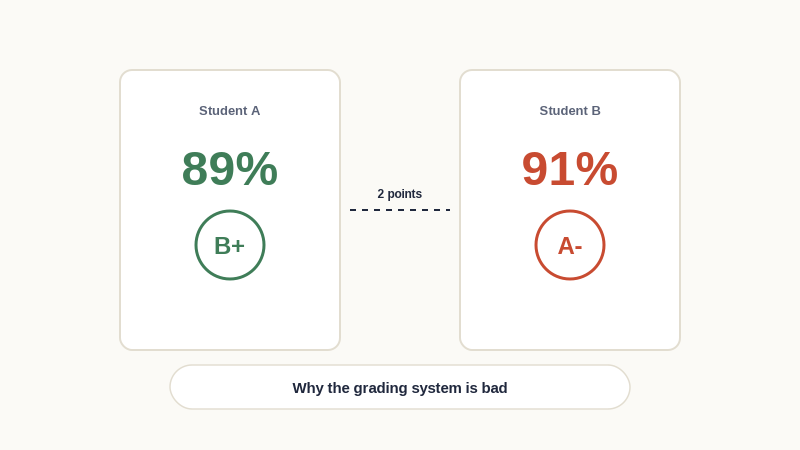
For the wider debate about letter grades, see why the grading system is bad, which covers both sides.
How to try ungrading in your class
You don't have to change everything at once. A low-risk way to start:
- Pick one unit or the first few weeks as a grade-free zone.
- Write comments that point forward: one thing that works, one thing to fix, one question.
- Allow revision. Feedback only helps if students can use it.
- Ask for a short reflection at the end: what did you learn, and what's your evidence?
- Keep the final say on grades, and tell students that at the start.
- Check your school's rules. Many K–12 districts and colleges set grading policies that limit what one teacher can change.
If going fully gradeless isn't possible, pass/fail grading is a middle step some schools already allow.
Frequently asked questions
Who invented ungrading?
The term is usually credited to Jesse Stommel, who began removing grades from his writing classes in the early 2000s. Susan D. Blum's 2020 book Ungrading made the idea widely known.
Is ungrading the same as pass/fail?
No. Pass/fail still gives a grade, just with two options. Ungrading removes grades from the work during the course and usually still gives a letter grade at the end.
Does ungrading work in K–12?
Some K–12 teachers use it, often for part of a course. School and district grading policies, report cards and gradebook software usually limit how far they can go.
Do students grade themselves in ungrading?
Often, but not always. Many teachers ask students to propose a grade with evidence, then keep the right to change it.
Does ungrading mean no feedback?
No, the opposite. Ungrading replaces scores with more feedback, usually written comments, conferences or peer review.
Does ungrading lead to grade inflation?
It can raise grades, because students are graded on where they end up and can revise. Teachers who keep the final say and ask for evidence in reflections limit this.
Can you ungrade a math or science class?
Yes. Teachers often use feedback-only problem sets, test corrections or specifications grading, where students must meet clear standards. Retakes and corrections work a lot like the extra credit alternatives many math teachers already use.